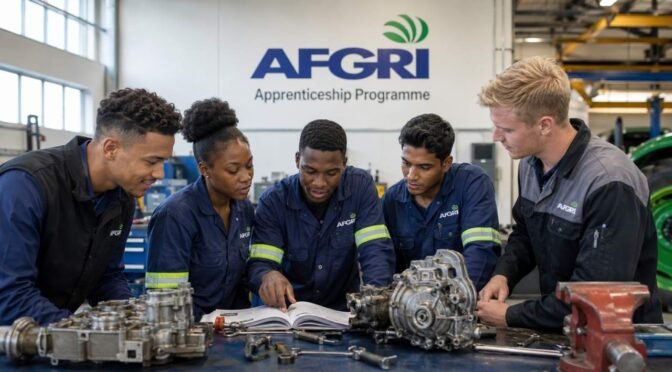
South Africa’s agricultural sector runs on machinery — tractors, harvesters, sprayers, and heavy earthmoving equipment that need constantly skilled hands to keep them running. For young South Africans who enjoy working with their hands, solving mechanical problems, and building a stable trade career, the AFGRI Apprenticeship Programme 2026 is one of the most credible entry points into the artisan world this year.
AFGRI Equipment, a long-standing dealer of John Deere machinery and other advanced agricultural equipment, has opened its 2026 intake for 40 apprenticeship positions, giving candidates the chance to qualify as either a Tractor Mechanic or an Earthmoving Mechanic. This is not a short course or an internship — it is a full three-year, SETA-linked artisan training pathway that leads to a nationally recognised trade qualification.
This article breaks down everything you need to know: who AFGRI is, who qualifies, what documents you’ll need, what the programme actually pays and covers, how the qualification process works, and exactly how to apply — step by step.
Employer Details
AFGRI Equipment has represented the John Deere brand in South Africa since 1962, making it one of the most established agricultural machinery dealerships in the country. The company services the North-East and South-West regions of South Africa through an extensive branch network that includes towns such as Polokwane, Nelspruit, Bellville, George, and Pietermaritzburg, among others. Beyond South Africa’s borders, AFGRI also has operations in countries including Botswana, Kenya, Uganda, and Western Australia.
As part of the wider AFGRI Group, AFGRI Equipment plays a central role in keeping South Africa’s commercial farms, construction sites, and earthmoving operations running by supplying, servicing, and repairing the heavy machinery that these industries depend on. Training the next generation of qualified artisans is central to the company’s long-term operational strategy, which is why the apprenticeship programme is run every year with structured intake cycles.
Eligibility
AFGRI is looking for motivated young South Africans who are serious about a long-term technical career rather than a short-term job. Based on the current 2026 intake criteria, applicants are generally expected to meet the following:
- Be a South African citizen
- Have completed Grade 12 (Matric) or hold an N2/N3 Engineering Certificate
- Be old enough to legally hold a valid driver’s licence and commit to a multi-year contract
- Have no prior work experience required — this is an entry-level technical training programme
- Show a genuine interest in mechanical, technical, or engineering work
- Be willing to relocate or travel to one of AFGRI’s regional training and workshop locations
- Be prepared to commit to the full duration of the apprenticeship, including the initial probation period
Candidates who already hold introductory technical qualifications, such as N2 or N3 subjects, or who have some exposure to diesel or motor trade theory, will have an advantage during shortlisting, though this is not always a strict requirement.
Requirements
To be considered for either the Tractor Mechanic or Earthmoving Mechanic route, applicants typically need to meet one of the following education pathways:
Option A — Matric Route
- Grade 12 (Matric) with Mathematics (not Mathematical Literacy) and Physical Science
- A minimum pass mark of around 50% in both subjects is generally preferred
- Additional relevant subjects such as Technical Science or Engineering Graphics and Design can strengthen an application
Option B — N2/N3 Route
- An N3 Engineering Certificate with passes in Mathematics, Engineering Science, and a relevant trade theory subject (such as Motor or Diesel Trade Theory)
Additional non-negotiable requirements:
- A valid driver’s licence (Code 8/B, manual) — this is described as essential across current listings, since apprentices need to move and test equipment as part of their training
- Strong mechanical aptitude and genuine interest in problem-solving with machinery
- Good communication skills, basic administrative ability, and basic computer literacy
- Willingness to work in rural, farm-based, or workshop environments
- Discipline, safety-consciousness, and the ability to work well in a team setting
If you do not yet hold the N2 qualification, AFGRI has in past intakes offered Further Education and Training support, allowing suitable Matric candidates to complete relevant N2 subjects as part of the broader apprenticeship structure.
Stipend
AFGRI Equipment fully covers the cost of formal training for apprentices who pass each module and stage of the programme — this is one of the most attractive aspects of the apprenticeship, since qualifying as an artisan through private institutions can otherwise be costly.
Regarding day-to-day pay, apprentices may receive a stipend during certain phases of the practical and workplace training, though the exact amount is not standardised or publicly published, and it can vary depending on the training stage, region, and specific contract terms. Because AFGRI has not released a fixed public stipend figure for the 2026 intake, applicants should confirm exact stipend details directly with AFGRI HR once shortlisted for an interview, rather than relying on third-party estimates.
It’s also worth noting an important condition: if an apprentice fails a module, they may become responsible for the cost of retaking that module and any additional time required — so consistent effort throughout the programme matters both for career progress and for avoiding extra costs.
Qualification Details
The AFGRI Apprenticeship Programme runs as a structured three-year artisan training pathway, built around two possible specialisations:
- Tractor Mechanic (Agricultural Equipment Technician) — focused on maintaining and repairing tractors, harvesters, sprayers, and other agricultural machinery, including both mechanical components and modern electronic diagnostic systems.
- Earthmoving Mechanic — focused on the servicing and repair of heavy earthmoving and construction equipment.
How the programme is structured:
- Probation (first 6 months): Both AFGRI and the apprentice assess whether the placement is a good long-term fit. Either party can withdraw during this period without the penalties that apply later in the contract.
- Formal Apprenticeship Contract: Once probation is successfully completed, apprentices sign a formal contract and begin structured training that combines hands-on workshop experience with theoretical coursework.
- Training Components: Training includes practical workshop repairs (engines, transmissions, hydraulic systems), distance learning modules, college-based theory subjects, supplier-specific product training (including John Deere systems), and internal AFGRI training programmes.
- SETA Alignment: Depending on the specific trade route, training is aligned with either AgriSETA or MerSETA, giving the qualification formal, recognised standing within South Africa’s skills development framework.
- Contract Duration Limit: The full apprenticeship contract cannot exceed four years in total. If an apprentice does not complete their qualification within that period, the contract expires.
- Work-Back Commitment: Should an apprentice withdraw during the contract or the required work-back period, they may be liable to repay training costs, with the work-back period generally equal to however long it took them to qualify.
By the end of the programme, successful apprentices walk away with a nationally recognised artisan qualification and practical, real-world experience on modern agricultural and earthmoving machinery — not just a certificate, but genuine employability.
Required Documents
While exact document checklists can vary slightly by intake, applicants should prepare the following before starting their online application:
- Certified copy of South African ID
- Certified copy of Matric certificate and results, or N2/N3 certificate and academic transcript
- Certified copy of a valid driver’s licence (Code 8/B)
- Updated CV detailing any relevant technical exposure, subjects, or work experience
- Proof of residence
- Any additional certificates (e.g., short technical courses, N-course subjects) that support the application
- Contactable references, where requested
Applicants should double-check that every section of the online application is complete and that personal details, school subjects, and driver’s licence information are entered correctly, since incomplete applications are a common reason candidates are not shortlisted.
Benefits/Career Scope
The AFGRI Apprenticeship Programme offers far more than just a three-year training contract. Key benefits include:
- Fully covered training costs for apprentices who pass their modules
- Real workshop experience on John Deere and other advanced agricultural and earthmoving machinery
- Formal, SETA-recognised qualification at the end of the programme
- Career stability — agriculture remains one of South Africa’s most essential industries, and qualified tractor or earthmoving technicians are in consistent demand
- Career progression opportunities, with pathways into roles such as Service Manager, Technical Support Specialist, or even Precision Agriculture (GPS/mapping) specialist roles as the industry becomes more tech-driven
- National and international exposure, given AFGRI’s footprint across South Africa and operations in countries like Botswana, Kenya, Uganda, and Australia
- No prior experience required, making it genuinely accessible to school leavers and technically minded young people
For someone starting out, this programme offers a realistic, structured route from Matric straight into a respected, in-demand trade — without the burden of self-funded training costs.
Application Process
Applications for the AFGRI Apprenticeship Programme must be submitted online, directly through AFGRI’s official careers portal — never through third parties requesting payment or personal documents outside the official system.
Step-by-step process:
- Visit the official AFGRI careers page at afgri.co.za/careers.
- Select “See our open positions” or “Apply at AFGRI today.”
- Search for the current Apprenticeship Programme listing (Tractor Mechanic / Earthmoving Mechanic).
- Click “Apply Now” and complete the required screening questionnaire — set aside at least 30 minutes, as it includes detailed assessment questions.
- Upload all required supporting documents (ID, Matric/N2-N3 results, driver’s licence, CV).
- Double-check every field, especially subjects passed and driver’s licence details, before submitting.
- If shortlisted, candidates will be contacted for an interview and a technical assessment at one of AFGRI Equipment’s regional offices.
Important dates and follow-up: Based on the current 2026 intake, applications are open with a stated closing date of 30 September 2026, though candidates are strongly encouraged to apply early rather than waiting for the deadline, as online systems can be slower to process during high-volume periods. If you have not been contacted within 30 days after the closing date, or by the end of November, you may consider your application unsuccessful for this intake.
Official Contact
For the most accurate and up-to-date information, always refer directly to AFGRI’s official channels rather than third-party job boards:
- Official website / careers portal: afgri.co.za/careers
- AFGRI Equipment programme page: afgriequipment.co.za
Because vacancy pages open and close throughout the year, always confirm that the apprenticeship listing is currently live before starting an application, and be cautious of any site or individual requesting payment, banking details, or upfront fees to “secure” a position — AFGRI does not charge applicants to apply.
Expert Tips
- Apply early. Application portals often slow down closer to the deadline, especially when screening questions and document uploads are involved.
- Get your driver’s licence sorted first. A valid Code 8 licence is treated as essential, not optional, so applicants without one may be automatically disadvantaged.
- Strengthen your Maths and Physical Science results if you’re still in school or repeating subjects — these are core to shortlisting decisions.
- Consider N2/N3 subjects if you don’t yet have strong Matric results; this can open the same door through a different route.
- Be ready for a technical assessment, not just an interview — brush up on basic mechanical reasoning and problem-solving before you’re shortlisted.
- Treat the probation period seriously. The first six months are a genuine two-way evaluation, so use this time to show reliability and eagerness to learn.
- Think long-term. With experience, this qualification can open doors into specialised fields like Precision Agriculture technology, not just traditional mechanical repair work.
Related Opportunities
If the AFGRI Apprenticeship Programme doesn’t align perfectly with your current qualifications, or you’d like to broaden your options, similar SETA-linked and artisan-track programmes are worth researching, including other agricultural and engineering apprenticeships, MerSETA/AgriSETA-funded learnerships, TVET college workplace-based learning (WIL) placements, and other large-scale artisan development programmes currently running in South Africa’s technical and agricultural sectors.
FAQ
Q: Do I need previous work experience to apply? No. The AFGRI Apprenticeship Programme is designed for entry-level candidates, and no prior work experience is required.
Q: Is a driver’s licence really compulsory? Yes. Across current listings, a valid Code 8 (B) manual driver’s licence is treated as essential, largely because apprentices need to move and test equipment during training.
Q: How much is the stipend? AFGRI has not published a fixed public stipend amount for the 2026 intake. Apprentices may receive a stipend during certain training phases, but this varies, so exact figures should be confirmed directly with AFGRI once shortlisted.
Q: What happens if I fail a module? Training costs are covered by AFGRI as long as you pass each module. If you fail a module, you may be responsible for the cost of retaking it and any additional time required.
Q: Can I leave the programme early? During the first six months of probation, either you or AFGRI can end the arrangement without penalty. After that, leaving early may require repaying training costs, based on a work-back period roughly equal to the time already spent in training.
Q: How long is the full apprenticeship? The programme runs for three years, though the total contract period (including any additional time needed) cannot exceed four years.
Q: When do 2026 applications close? Based on current listings, applications close on 30 September 2026, though this should always be reconfirmed on the official AFGRI careers portal, as dates can be updated.
Disclaimer
This article is intended for general informational purposes only, based on publicly available information about AFGRI’s Apprenticeship Programme at the time of writing. Programme details, eligibility criteria, closing dates, stipend arrangements, and application procedures are subject to change at AFGRI’s discretion. Readers are strongly encouraged to verify all details directly through AFGRI’s official careers portal (afgri.co.za/careers) before applying. This article is not affiliated with, endorsed by, or an official communication from AFGRI Equipment or the AFGRI Group. Beware of any third party requesting payment, banking information, or personal documents in exchange for guaranteed placement — legitimate employers, including AFGRI, do not charge job seekers to apply.
Trust Box
- ✅ Published by: CareerScope Editorial Team
- ✅ Last Updated: 27 July 2026
- ✅ Information Source: Official Career Portal & Organisation Announcement
- ✅ Status: Verified & Reviewed for Accuracy